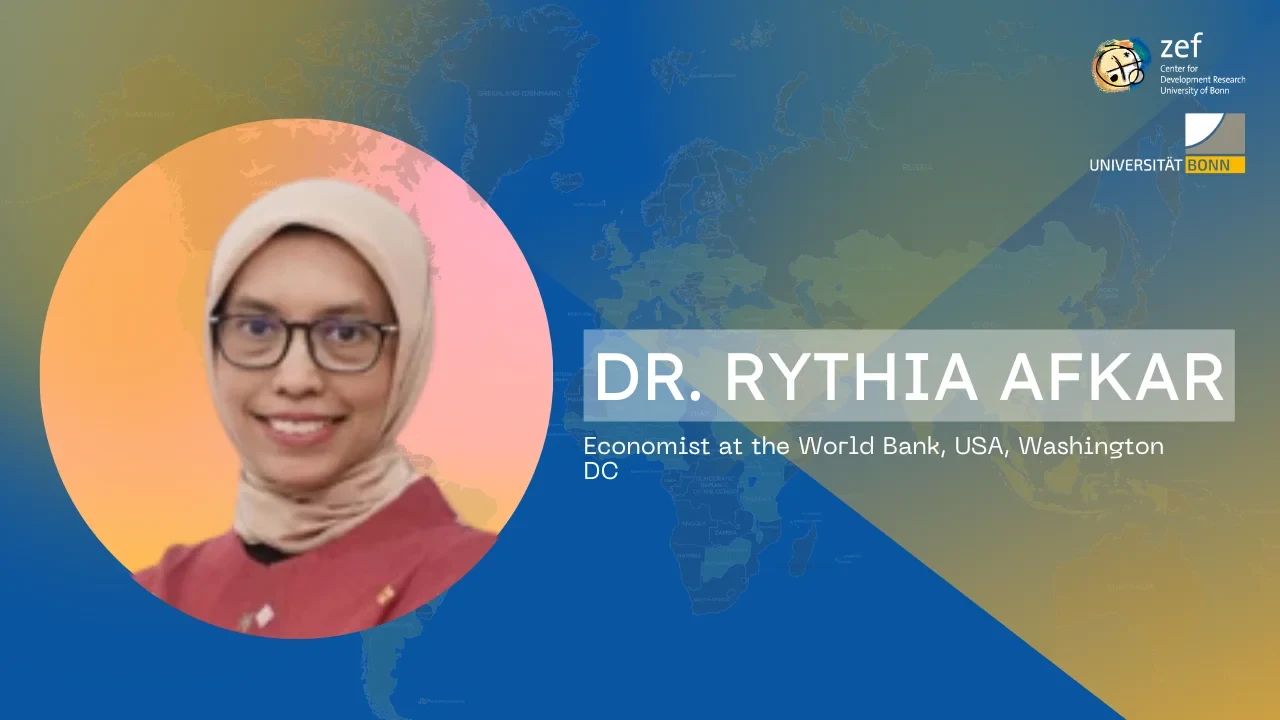
Dr. Rythia Afkar
Economist at the World Bank, USA, Washington DC
"Through my job at the World Bank, which I was able to take on after completing my PhD, I contributed directly to the development agenda, particularly in the areas of education and human capital development. These engagements helped translate research and academic training into practical development outcomes on the ground. Without the DAAD EPOS scholarships, we lose far more than individual opportunities; we lose a vital connection between Germany and the countries and institutions its alumni serve. We lose the opportunity for talented individuals to contribute meaningfully to the global development agenda.”
Main career stages: International Organization (World Bank)
Current position: Economist
Graduation: 2016 from the University of Bonn.
How have the DAAD scholarship and the doctoral degree impacted your career?
The DAAD scholarship and my doctoral degree have had a profoundly positive impact on my career. The PhD scholarship gave me the opportunity to gain advanced research skills and build an international academic network, which allowed me to take up a position as an Economist at the World Bank. Beyond the technical and academic training, the experience broadened my perspective and gave me the confidence and credibility to take on responsibilities such as leading research and analytical teams and advising government. Without the DAAD scholarship, I would not have had access to the same quality of doctoral training, mentorship, and international exposure that shaped the trajectory of my career.
Which cooperation and development did you initiate or strengthen in your country/ institution?
Through the work I was able to take on after completing my PhD, I contributed directly to the development agenda, particularly in the areas of education and human capital development. This work extended beyond my own country, Indonesia, to China, PNG, Saudi Arabia, as well as countries in South Asia and Sub-Saharan Africa regions, where I conducted analytical work and supported strategic priority and design of human capital policies. These engagements helped translate research and academic training into practical development outcomes on the ground.
Which collaboration do you maintain with German institutions/ the University of Bonn until today?
I maintain a relationship as an alumna with my alma mater/ the University of Bonn and contribute to the other German academic community as a reviewer for a journal publication affiliated with the University of Wuppertal.
What do we lose if the DAAD EPOS scholarship is canceled? How would the Global South, North, and West be affected?
I think we would lose far more than individual opportunities; we would lose a vital connection between Germany and the countries and institutions its alumni serve. We would lose the opportunity for talented individuals to contribute meaningfully to the global development agenda, and we would lose the tangible, on-the-ground impact that alumni continue to make by applying what they learned directly in their fields such as in education, human capital development, agriculture, climate, and beyond. The scholarship is not just an individual investment; it is a bridge that sustains cooperation, knowledge exchange, and real development outcomes long after the degree is completed.