Dr. Seid Nuru Ali, Ethiopia
Technical Advisor to the President of Amhara Regional State, Ethiopia
"I joined the ZEF doctoral Program in 2004 with generous support from Germany through DAAD, German Agency for Technical Co-operation (GTZ), and German Federal Ministry for Economic Cooperation and Development (BMZ). I held a position of Senior Researcher at ZEF. Global cooperation in this era of apparent lawlessness is key. I do believe most DAAD alumni are ambassadors of Germany. Cancellation of the DAAD EPOS funding would cost Germany its important social capital globally."
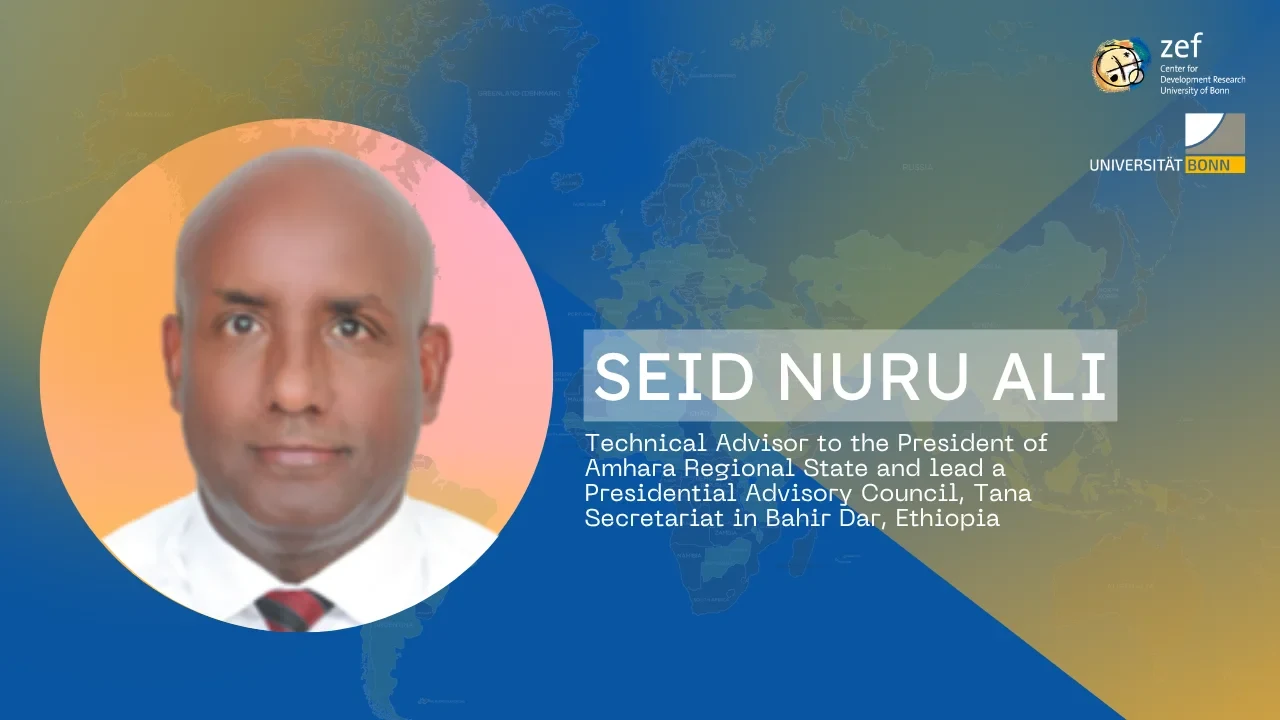
Seid Nuru Ali joined the ZEF PhD Program in 2004 with support from the German people through DAAD, German Agency for Technical Co-operation (GTZ), German Federal Ministry for Economic Cooperation and Development (BMZ).
Graduation: He graduated with a Ph.D. in Economics from the University of Göttingen in 2007, under the supervision of the late Prof. Stephen Klasen.
In what ways have the DAAD scholarship and your doctoral degree impacted your career?
I received a quality education in Germany. In addition to the participatory and multidisciplinary teaching methods, the educational materials, which are rare back home, and the work ethic and discipline of German society, I was able to expand my understanding of development through the efficient institutions.
Because of the quality education I received in Germany, the German work ethic and discipline I adopted, and the efficiency of its institutions, I have been promoted to major career steps and won the trust of the Ethiopian authorities. These are important values that I hold dear and strive to apply in my home country.
When I presented research outcomes and analyses of the Ethiopian development process at international forums, people asked me where I was educated. I always received a nodding complement when I answered Germany.
What cooperation and development initiatives did you start or strengthen in your country or institution?
I served as a senior research fellow for the Ethiopian Economic Association for about nine years. The association had a strong research collaboration with ZEF.
What would we lose if the DAAD EPOS scholarship were canceled? How would the Global South, North, and West be affected?
The first is humanitarian. In my view, being a true friend to the poor means creating sustainable capacity so they will not be poor again. If a society must maintain high standards of values and morals by doing the right thing, there is nothing more important than lending a helping hand to those in need. This means more than just distributing food handouts during times of crisis; it means building capacity so they can help themselves.
2. The second is mutual well-being. In this era of globalization, migration to the West is inevitable. Supporting talented youth through programs like DAAD benefits both parties. First, scholarship recipients like me can contribute to our home countries. Second, if they choose to stay in Germany, they can contribute to the German economy, unlike illegal immigrants.
3. Global cooperation in this era of apparent lawlessness: Germany is in my heart, as well as in the hearts and minds of my family. We are truly ambassadors of Germany wherever we go. After all, I am a proud product of ZEF and DAAD—and, of course, Germany, a name that signifies quality!
Just a week ago, my son, who experienced Germany in kindergarten and is now a second-year college student in the U.S., appeared on a video call with me wearing a German national team T-shirt. He told me that he was heading out to watch the game with his friends.
I believe that most DAAD alumni are ambassadors of Germany. If so, canceling the DAAD program would cost Germany important social capital globally.
Career Stages
I held a position of Senior Researcher at ZEF, coordinated the PhD Program of the Department of Economic and Technological Change at ZEF, taught Advanced Econometrics, as well as Advanced Development Macroeconomics at ZEF, University of Bonn, from 2008 to 2010.
I held a position as a Senior Research Fellow and Head of the Macroeconomic Division at the Ethiopian Economics Association and collaborated with ZEF from 2010 - 2018.
In 2019, I held a position of Residence Technical Advisor at the Ministry of Planning and Development of the Federal Democratic Republic of Ethiopia and Lead Planner of the Ten – Year Development Plan of Ethiopia, which is currently being implemented.
In 2020, I moved to the Amhara National Regional State at the rank of Deputy Head of Government mainly to lead the preparation of the Ten – Year Development Plan of the state.
Over the last two and half years, I successfully led the preparation of the 25 – Year Roadmap for Transformative Growth and Sustainable Development of the Regional State of Amhara.
Currently, I serve as the Technical Advisor to the President of Amhara Regional State and lead a Presidential Advisory Council called the Tana Secretariat in Bahir Dar, Ethiopia.
I taught development economics and econometrics in major universities in Ethiopia.