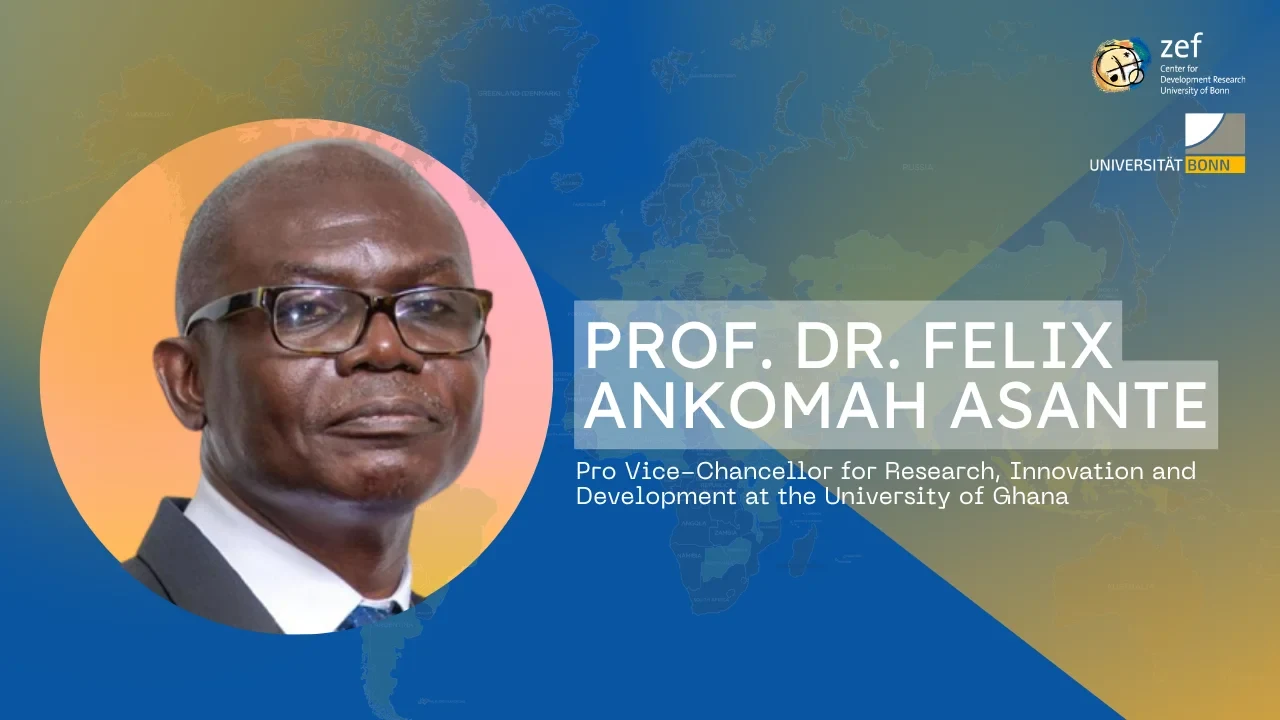
Prof. Dr. Felix Ankomah Asante, Ghana
Pro Vice-Chancellor for Research, Innovation and Development at the University of Ghana
“The German system and culture have influenced my work as a senior university administrator in my home University of Ghana. Throughout the last 20 years, I collaborated with other researchers at ZEF to supervise PhD students and run joint research projects. After more than 20 years of fruitful cooperation, the University of Bonn and the University of Ghana recently got a new joint DFG-funded Collaborative Research Center (CRC) on Food System Transformation for Sustainable Nutrition (FoodDiverse) approved. Cancelling the DAAD EPOS funding means losing current and future research collaboration on pressing challenges, such as climate change and food systems. This type of research collaboration allows both countries to learn from each other and deepen insights.”
Main career stages: Director of the Institute of Statistical, Social and Economic Research (ISSER), University of Ghana, from 2013 to 2019. He has also served in various capacities at ISSER as Deputy Director from 2011 to 2013 and Head of the Economics Division from 2007 to 2011.
Graduation: Defended his doctoral thesis in 2002.
In what ways have the DAAD scholarship and your doctoral degree impacted your career?
It has impacted my career through collaboration with my German supervisor, senior researchers from ZEF and through collaboration on research projects with ZEF. The German system and culture have influenced my work as a senior university administrator in my home university. Partnered with other senior colleagues at ZEF I supervise PhD students on topics related to Ghana.
What cooperation and development initiatives did you start or strengthen in your country or institution?
The University of Ghana, in collaboration with ZEF, was awarded a DAAD grant to set up a Center of Excellence in Development Studies in Ghana. The DAAD support from 2009 to 2020 trained over 60 PhD students I over ten years’ time. These PhD students mainly came from Ghana and a few from sub-Saharan African countries such as Tanzania and Uganda. They are all employed and continue to contribute to the development of their respective countries. The Center of Excellence has helped reduce the brain drain from Ghana. Since the end of the DAAD support the Center has still been actively collaborating with ZEF in supporing PhD training in Ghana.
Which collaboration do you maintain with German institutions and/or with the University of Bonn?
Ghanaian- German Centre for Development Studies, since 2008. In addition, the University of Bonn and the University of Ghana recently got a new joint DFG-funded Collaborative Research Center (CRC) on Food System Transformation for Sustainable Nutrition (FoodDiverse) approved.
What would we lose if the DAAD EPOS scholarship were canceled? How would the Global South, North, and West be affected?
As a country in the Global South, Ghana will lose the opportunity to collaborate with German institutions like ZEF to train the next generation of academics in Ghana. Additionally, the opportunity to collaborate on researching pressing developmental challenges, such as climate change and emerging issues in food systems, among others, will be lost. This type of research collaboration enables both countries to learn from each other and strengthen their partnership.