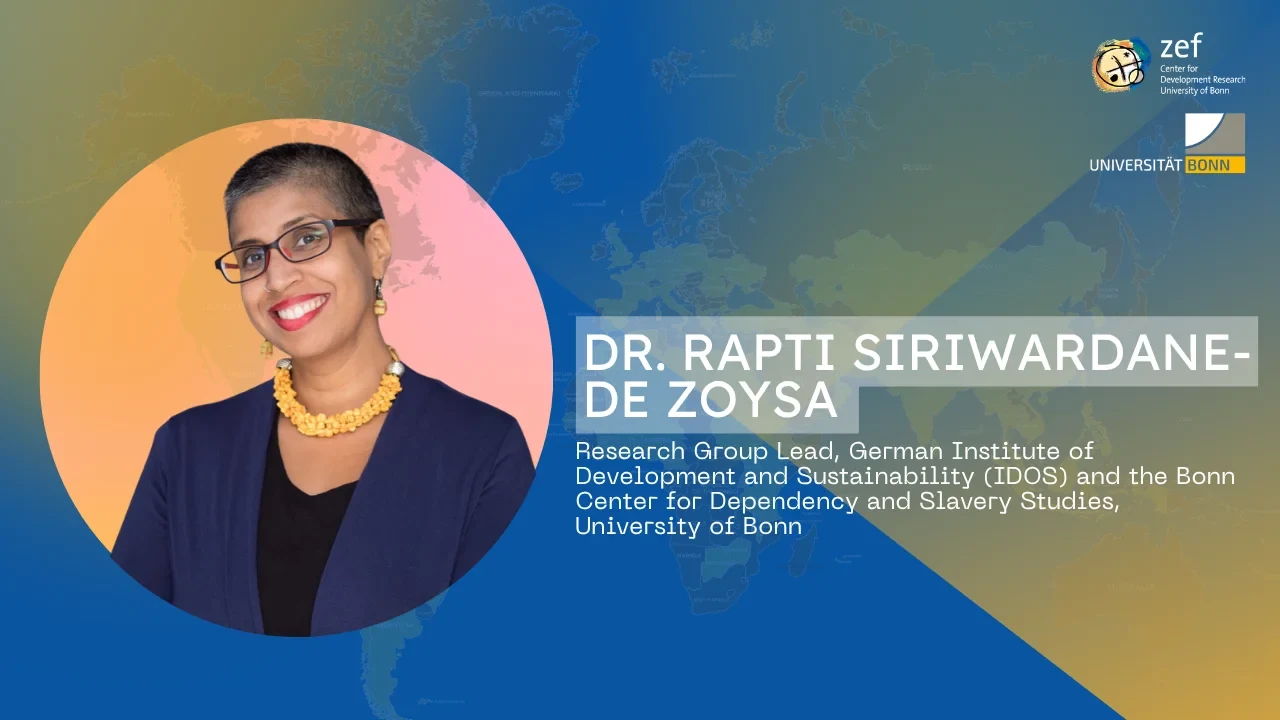
Dr. Rapti Siriwardane-de Zoysa, Sri Lanka
Research Group Lead, German Institute of Development and Sustainability (IDOS) and the Bonn Center for Dependency and Slavery Studies, University of Bonn
“Over the past nine years, I have contributed to strengthening Germany’s international academic and development cooperation from within German institutions. As a mid-career academic successful in third-party funding acquisition, I have initiated and expanded collaborations with partners across Ecuador, the Dutch Caribbean, Jamaica, Indonesia, India, Mauritius, the Philippines, South Africa, Sri Lanka, Singapore, and the USA. In this sense, my work has not only benefited my own career but has helped position German academia as an active partner in international knowledge production, especially with scholars and institutions beyond the usual Euro-American centres. Cancelling the DAAD EPOS scholarship feels like an act of strategic self-sabotage. What it does is dismantle an entire pipeline of science, policy, and development diplomacy. This is not simply a matter of “cutting a scholarship line” or shedding many non-descript beneficiaries. At a time when Germany urgently needs more global allies and more diverse partnerships, not fewer, cancelling DAAD EPOS is profoundly short-sighted. It closes a proven channel of cooperation exactly when such channels are most needed. What Germany loses is not only talent, but trust, reach, reciprocity, and influence.”
Graduation: 2015 from the University of Bonn.
In what ways have the DAAD scholarship and your doctoral degree impacted your career?
After completing my Masters in Geography at Oxford with distinction, the ZEF–DAAD doctoral program gave me the intellectual freedom to develop as an independent scholar, beyond the constraints of a narrowly project-driven PhD. It enabled conceptual experimentation and the development of an original research trajectory.
With DAAD support, I completed my doctorate summa cum laude and by monograph in 2015, later published in Springer’s Maritime Studies series. That scholarship did not simply fund a degree but helped launch my career as an academic, author, student advisor, and project lead at the University of Bonn. Its impact continues today in my work as a senior researcher at the German Institute of Development and Sustainability (IDOS), where I contribute to international research collaboration, third-party funding acquisition, and the internationalization of the Faculty of Philosophy at the University of Bonn.
What cooperation and development initiatives did you start or strengthen in your country or institution?
Over the past nine years, I have contributed to strengthening Germany’s international academic and development cooperation from within German institutions. As a mid-career academic successful in third-party funding acquisition, I have initiated and expanded collaborations with partners across Ecuador, the Dutch Caribbean, Jamaica, Indonesia, India, Mauritius, the Philippines, South Africa, Sri Lanka, Singapore, and the USA.
Through funding from bodies including the SSRC in the United States and an EU COST Action, I have helped bring German institutions (in this case the Leibniz Centre for Tropical Marine Research/ZMT, Bremen and Uni Bremen) into wider transregional research networks on development, sustainability, coastal and ocean governance, and knowledge inequalities. These collaborations have supported joint book publications and workshops, MA training, policy engagement, and long-term scholarly exchange.
In this sense, my work has not only benefited my own career but has helped position German academia as an active partner in international knowledge production, especially with scholars and institutions beyond the usual Euro-American centers.
Which collaboration do you maintain with German institutions and/or with the University of Bonn?
I presently work for the University of Bonn and IDOS.
What would we lose if the DAAD EPOS scholarship were canceled? How would the Global South, North, and West be affected?
Canceling the DAAD EPOS scholarship felt like an act of strategic self-sabotage. What it did was dismantle an entire pipeline of science, policy, and development diplomacy. This was not simply a matter of “cutting a scholarship line” or shedding a number of non-descript beneficiaries.
EPOS has trained generations of international scholars and practitioners who have gone on to become leading academics, politicians, policy advisers, civil society leaders, and institutional partners across diverse parts of the world.
At a time when Germany urgently needs more global allies and more diverse partnerships, not fewer, cancelling EPOS is profoundly short-sighted. It closes a proven channel of cooperation exactly when such channels are most needed. What Germany loses is not only talent, but trust, reach, reciprocity, and influence. Daresay, what this decision has done is undermine one of the most effective instruments of international cooperation it already has.