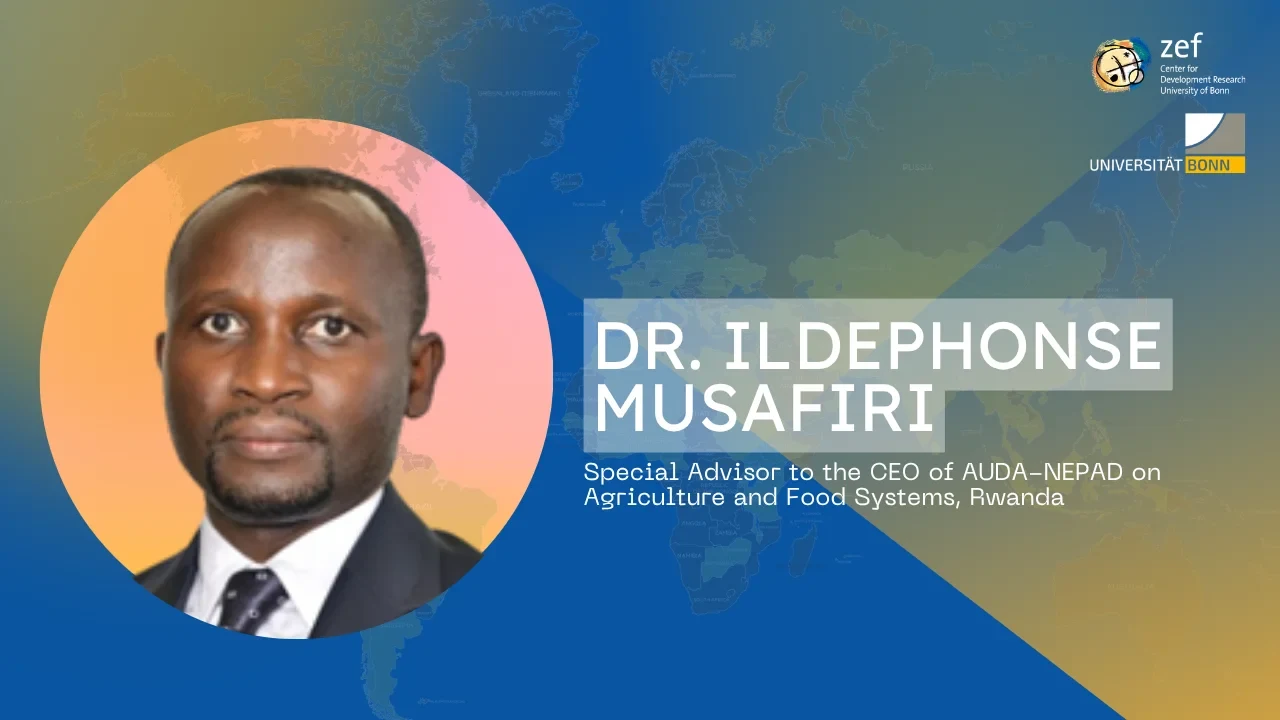
Dr. Ildephonse Musafiri, Rwanda
Former Minister of Agriculture and Animal Resources; today Special Advisor to the CEO of African Union Development Agency (AUDA-NEPAD)
“The DAAD EPOS scholarship was not only an investment in my education; it became an investment in public service and the development of my home country. I have used the knowledge and confidence gained through my doctoral training to support evidence-based policymaking and institutional coordination. In the Office of the President of Rwanda, I advised on economic and development priorities and helped coordinate implementation across government. In my current work, I also engage with German development institutions, including GIZ, where our priorities intersect. The relationships created through DAAD have therefore continued well beyond the scholarship period and remain relevant to my work in Africa. My own journey shows the multiplier effect of one scholarship: it supported one student, but its benefits have extended to public institutions, national development and now continental food-systems transformation.”
Main career stages: Academic and researcher; Senior economic and policy adviser in the Office of the President of Rwanda; Minister of Agriculture and Animal Resources; Special Advisor to the CEO of the African Union Development Agency (AUDA-NEPAD).
Current position: Special Advisor to the CEO of AUDA-NEPAD on Agriculture and Food Systems.
Graduation: 2015 from the University of Bonn.
In what ways have the DAAD scholarship and your doctoral degree impacted your career?
The DAAD scholarship changed the course of my life. It enabled me to pursue a PhD in Agricultural Economics at the Center for Development Research, University of Bonn, and gave me advanced analytical skills, international exposure and a lasting professional network.
Since completing my PhD, my life has never been the same. I moved from academia and research into senior policy advisory roles in the Office of the President of Rwanda, later served as Minister of Agriculture and Animal Resources, and now contribute to food-systems transformation across Africa through AUDA-NEPAD. The scholarship was therefore not only an investment in my education; it became an investment in public service and development.
What cooperation and development initiatives did you start or strengthen in your country or institution?
I have used the knowledge and confidence gained through my doctoral training to support evidence-based policymaking and institutional coordination. In the Office of the President, I advised on economic and development priorities and helped coordinate implementation across government.
As Minister of Agriculture from 2022 to 2024, I strengthened programmes related to food security, agricultural productivity, climate-smart agriculture, irrigation, research, agribusiness and partnerships with development institutions. During this period, Rwanda’s economy remained resilient: GDP grew by 8.2% in 2023 and 8.9% in 2024, while agricultural growth rose from 2% to 5%.
Today, at AUDA-NEPAD, I am applying this experience at continental level by supporting African countries in transforming food systems, mobilizing investment and strengthening climate resilience.
Which collaboration do you maintain with German institutions and/or with the University of Bonn?
I remain a proud and active DAAD alumnus and continue to value my professional and academic links with the University of Bonn and ZEF. These relationships continue through professional networks, knowledge exchange and engagement with researchers and development practitioners.
In my current work, I also engage with German development institutions, including GIZ, where our priorities intersect. The relationships created through DAAD have therefore continued well beyond the scholarship period and remain relevant to my work in Africa.
What would we lose if the DAAD EPOS scholarship were canceled? How would the Global South, North, and West be affected?
Cancelling or suspending the DAAD EPOS scholarship would mean losing far more than opportunities for individual students. It would weaken a proven pathway for developing the researchers, policymakers, public servants and institutional leaders that Africa urgently needs.
Africa continues to face major human-capacity gaps alongside serious challenges in food security, climate change, health, governance, infrastructure and economic transformation. DAAD has been instrumental in equipping African professionals to return home, support their families, strengthen institutions and contribute to national and continental development.
My own journey shows the multiplier effect of one scholarship: it supported one student, but its benefits have extended to public institutions, national development and now continental food-systems transformation. Suspending such opportunities would close doors for thousands of talented Africans and deny millions of people the wider benefits of their future service.
At a time when Africa most needs skilled leadership and stronger international cooperation, the DAAD EPOS program should be strengthened, not discontinued.