

CRC 1780: Food System Diversification for Sustainable Nutrition (FoodDiverse)
Spokesperson: Prof. Dr. Matin Qaim (agricultural economics)
Vice-Spokesperson: Prof. Dr. Ute Nöthlings (nutrition epidemiology)
This page provides a short overview of the overall CRC, its different projects, and the types of positions available in each project.
The CRC is funded by the German Research Foundation (DFG).
Total number of positions:
24 doctoral researchers &
8 postdoctoral researchers
in the broader field of sustainable food systems
At the bottom of the page, you find the link to the application portal and some further instructions. Applications are welcome until 14 June 2026.
Overview of overall CRC
Current food systems are not sustainable. Many people worldwide consume unhealthy diets and suffer from nutrition-related diseases. Agricultural production has serious negative environmental impacts, while environmental change further obstructs progress towards the goals of food security, healthy nutrition, and equitable human development. Major food system transformations are, therefore, needed. One type of transformation widely considered useful is food system diversification. Diversification is relevant at all levels and scales of food systems, including fields, farms, farming landscapes, markets, trade flows, diets, and sources of foods, among others. More diversity can potentially contribute to multiple benefits, such as positive environmental outcomes, healthier nutrition, disease prevention, productivity gains, and systems resilience. However, diversification may also be associated with costs. The various benefits and costs are expected to depend on the context, the degree of diversification, and the spatial scale considered.
The two central research questions to be addressed in this CRC are: (1) How do different types of food system diversification influence key aspects of planetary health, with their multiple dimensions of human health and wellbeing and the health of natural systems? (2) What characterizes favorable degrees of diversity, and how can they be achieved at different food system levels and spatial scales? These research questions are addressed in Germany and Ghana. Analysis with micro-data from farms, households, and individuals are complemented with remote sensing data and regional and global modeling work. The CRC is conducted in close partnership with the University of Ghana.
Overview of CRC projects
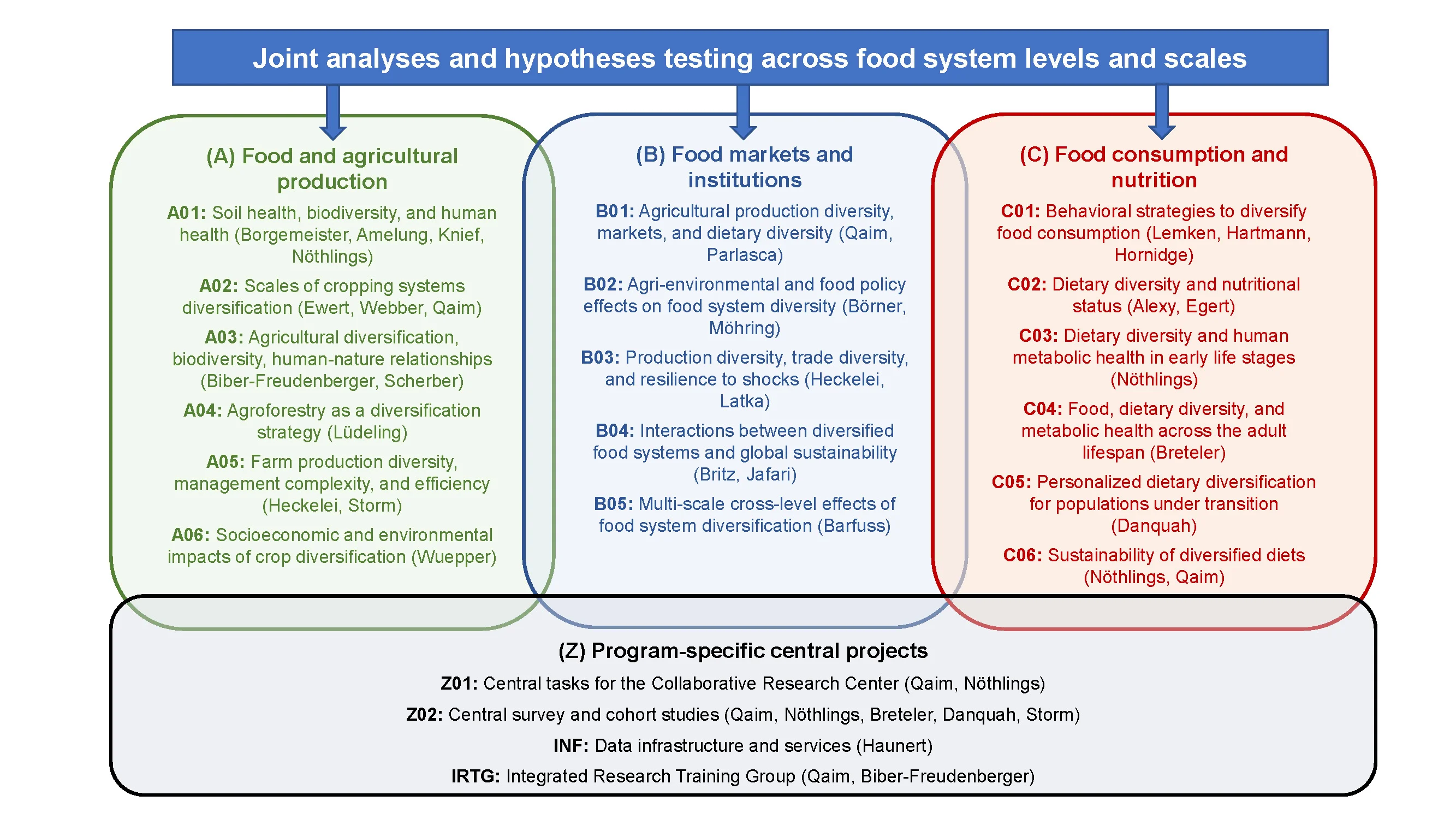
Project descriptions and open positions
A01 investigates how and to what extent agricultural diversification may improve soil health and human health through its effects on plant and soil biodiversity. It links farm-level crop and non-crop diversity to changes in soil and plant chemistry and microbiota composition, and ultimately to human health outcomes such as gut microbiota and nutrient adequacy. Using surveys and fieldwork in Ghana, as well as existing national datasets and spatial analyses in Germany, the project tests ecological pathways that connect diversified production to improved ecosystem and human health under different socioeconomic conditions.
Project leaders: Prof. Dr. Christian Borgemeister, Prof. Dr. Wulf Amelung, Prof. Dr. Claudia Knief, Prof. Dr. Ute Nöthlings (Ghana counterparts: Prof. Dr. Dora Nina, Prof. Dr. Daniel Etsey Dodor)
Positions at University of Bonn:
- 1 doctoral researcher with expertise in soil and plant nutrient analysis, including sampling design and laboratory techniques (e.g., ICP, AAS, elemental analysis)
- 1 doctoral researcher with expertise in soil ecology, agroecosystem biodiversity assessment, and field and laboratory methods for soil fauna and vegetation analysis
- 1 postdoctoral researcher in bioinformatics and molecular microbial ecology (joint with project C03)
A02 focuses on understanding how cropping system diversification contributes to multiple ecosystem services, such as yield magnitude and stability, soil carbon sequestration, and reduced environmental pollution, among others. It investigates the appropriate temporal and spatial scales (field, farm, landscape) of diversification that can minimize potential tradeoffs between short-term climate risk reduction and longer-term sustainability outcomes in Ghana and Germany. Survey data and statistical analysis are combined with focus group discussions as well as agroecosystem and bioeconomic modeling.
Project leaders: Prof. Dr. Frank Ewert, Prof. Dr. Heidi Webber, Prof. Dr. Matin Qaim (Ghana counterparts: Prof. Dr. Dilys MacCarthy, Dr. Martha Awo)
Positions at University of Bonn and Leibniz-Zentrum für Agrarlandschaftsforschung (ZALF), Müncheberg:
- 2 doctoral researchers in crop science/agronomy
A03 examines how agricultural diversification relates to biodiversity at field and landscape scales, and how these ecological patterns connect to human-nature relationships. Combining biodiversity data on plants, birds, bats, and insects from farming landscapes with household survey data and remote-sensing measures of landscape diversity, it investigates ecological-social interactions of farm diversification in Ghana and Germany. Through spatial analyses, the project further links biodiversity to people’s environmental perceptions, values, and aspects of mental wellbeing.
Project leaders: Prof. Dr. Lisa Biber-Freudenberger, Prof. Dr. Christoph Scherber (Ghana counterpart: Prof. Dr. Erasmus Owusu)
Positions at University of Bonn and Leibniz-Institute for the Analysis of Biodiversity Change (LIB), Bonn:
- 1 doctoral researcher in biodiversity research with a focus on tropical ecosystems and proven field work experience
- 1 doctoral researcher in biodiversity research with a focus on statistical data analysis and with geospatial datasets
A04 investigates effects of agroforestry adoption (integration of trees) on farm productivity, income, dietary quality, and biodiversity. Further, it analyzes barriers to agroforestry adoption, and how these can be overcome through improved policies. The analysis draws on survey data and case studies in Ghana and Germany. Participatory modeling with farmers, advisors, and policymakers is used to simulate how different policy instruments may affect farmers’ adoption decisions. The insights will help develop a theory of change, combining behavioral, institutional, and ecological perspectives.
Project leader: Prof. Dr. Eike Lüdeling (Ghana counterparts: Dr. Naalamle Amissah, Dr. Christiana A. Amoatey)
Positions at University of Bonn:
- 1 doctoral researcher in agronomy/agroforestry or similar
A05 explores how different types and degrees of agricultural diversification affect farm labor requirements, management complexity, managerial control, and resource use efficiency. The project uses farm survey data from Ghana and Germany to quantify tradeoffs between diversification benefits and managerial challenges under different socioeconomic and agricultural conditions. Novel Bayesian Probabilistic Programming approaches are employed to build hybrid models that combine theory-based economic concepts with flexible deep learning methods.
Project leaders: Prof. Dr. Thomas Heckelei, Dr. Hugo Storm (Ghana counterpart: Prof. Dr. Edward Onumah)
Positions at University of Bonn:
- 2 doctoral researchers in agricultural economics
A06 combines remotely sensed large-scale satellite data with household survey data to examine how crop diversification affects socioeconomic, agricultural, and environmental outcomes. It applies statistical and machine learning methods of causal inference to systematically identify under which conditions crop diversification at different scales has positive and negative effects on the environment and people’s wellbeing. Looking at both Ghana and Germany and also accounting for wider landscape interactions, key outcomes include indicators of crop yield, biodiversity, soil health, income, nutrition, and health.
Project leader: Prof. Dr. David Wuepper (Ghana counterpart: Prof. Dr. Gerald Yiran)
Positions at University of Bonn:
- 1 doctoral researcher in agricultural economics / environmental economics
B01 investigates how markets mediate the relationship between agricultural production diversity, dietary diversity, and nutrition. Using household and individual-level survey data from Ghana and Germany, it examines agricultural production patterns, marketing channels, value chains, and food environments. In Ghana, a market survey will be conducted and spatially linked to individual production and consumption data. In Germany, the focus lies on consumers’ food preferences, including shopping and eating habits. Seasonality serves as a cross-cutting lens throughout the analyses in both countries. Data are analyzed with econometric methods.
Project leaders: Prof. Dr. Matin Qaim, Dr. Martin Parlasca (Ghana counterparts: Prof. Dr. Fred Dzanku, Dr. Martha Awo)
Positions at University of Bonn:
- 1 postdoctoral researcher in agricultural economics
- 1 doctoral researcher in agricultural economics
Agri-environmental policies and food standards aim to reduce environmental burdens, but may also create unintended effects on land use and production diversity. B02 examines how public- and private-sector policies shape agricultural diversity and farm performance in Ghana and Germany. The project uses quasi-experimental methods combined with survey, census, spatial, and remote-sensing data. The main objective is to better understand how policies influence farmers’ production choices and identify entry points for more sustainable food-system governance.
Project leaders: Prof. Dr. Jan Börner, Prof. Dr. Niklas Möhring (Ghana counterpart: Prof. Dr. Simon Bawakyillenuo)
Positions at University of Bonn:
- 2 doctoral researchers in agricultural / environmental economics
B03 examines how different forms of diversity in production and trade influence the resilience of food and nutrition security to domestic supply shocks and international market disruptions. Focusing on sub-Saharan Africa and the role of Europe as a major trading partner, the project analyzes how production and trade diversity affect local food prices, and how these prices influence nutrition outcomes using quantitative econometric methods, probabilistic programming and computational modeling. For Ghana, an agent-based dynamic market model is developed to evaluate what degrees of agricultural production and trade diversity would be most useful to achieve sustainability and resilience goals.
Project leaders: Prof. Dr. Thomas Heckelei, Dr. Catharina Latka (Ghana counterpart: Dr. Yaw Osei-Asare; Collaborator: Prof. Dr. Kathy Baylis)
Positions at University of Bonn:
- 2 doctoral researchers in (agricultural) economics (one with a focus on econometric analyses, one with a focus on the agent-based market modeling)
B04 examines how widespread food system diversification would affect planetary health through international market feedbacks. Combining a multi-regional computable general equilibrium (CGE) model with environmental and nutritional data, the project simulates diversification scenarios and quantifies their impacts on trade flows, human wellbeing, and various environmental outcomes. The effects of changes in dietary preferences and policies are analyzed up to the year 2050. For Ghana and Germany, additional household-level data are used to assess distributional aspects through post-model micro-simulation.
Project leaders: PD Dr. Wolfgang Britz, PD Dr. Yaghoob Jafari (Ghana counterpart: Prof. Dr. William Baah-Boateng)
Positions at University of Bonn:
- 1 postdoctoral researcher in agricultural economics
B05 investigates how diversification influences the relationships between resilience, efficiency, and sustainability in the food system. Building on portfolio theory, the project develops a mathematical modelling framework to capture the multi-scale and cross-level nature of decision-making, especially across the key food system levels of production, trade, and consumption. Leveraging the empirical work across the CRC, B05 will identify synergies and tradeoffs of different forms of diversification, and also analyze how diversification shapes food system performance under different shocks.
Project leader: Prof. Dr. Wolfram Barfuss (Ghana counterpart: Prof. Dr. Kwabena Doku-Amponsah)
Positions at University of Bonn:
- 1 doctoral researcher in systems modeling
C01 explores behavioral and institutional factors that shape diet diversification. Particular focus is given to consumers’ capabilities, opportunities, and motivations. Based on surveys, qualitative studies, and targeted interventions in Ghana and Germany, the project identifies consumer segments and key motivational drivers to design strategies that support healthier and more sustainable food consumption. In addition, it will be examined how institutional and policy frameworks (incl. incentive mechanisms, regulations, and public discourses) influence food consumption.
Project leaders: Prof. Dr. Dominic Lemken, Prof. Dr. Monika Hartmann, Prof. Dr. Anna-Katharina Hornidge (Ghana counterparts: Prof. Dr. Ama de-Graft-Aikins, Prof. Dr. Felix Asante)
Positions at University of Bonn and German Institute of Development and Sustainability (IDOS), Bonn:
- 2 doctoral researchers in agricultural economics / consumer behavior
- 1 doctoral researcher in sociology
C02 examines how different indicators of dietary diversity are linked to nutritional status and biomarkers of essential nutrients. Using anthropometric, dietary, and biochemical data from Ghana and Germany, it is analyzed how dietary patterns relate to physiological health and nutrient levels, with particular attention to risk nutrients important for long-term health, including vitamins A, E, and B12, as well as iron, selenium, iodine, and zinc. While the focus is on childhood and adolescence, the project also draws on adult data to capture nutritional dynamics across the entire lifespan.
Project leaders: PD Dr. Ute Alexy, Prof. Dr. Sarah Egert (Ghana counterpart: Dr. Esi Colecraft)
Positions at University of Bonn:
- 2 doctoral researchers in nutrition / nutrition physiology
C03 examines how different dietary diversity patterns relate to metabolic health in Ghana and Germany across childhood and adolescence. It develops a range of dietary diversity metrics for different age groups and intake periods and evaluates how well these metrics capture diet quality, measured through nutrient adequacy and alignment with national dietary guidelines. The project also explores associations between dietary diversity and metabolic health indicators, including BMI, clinical biomarkers, and potential gut microbiome pathways, while accounting for seasonal variation in the study regions.
Project leader: Prof. Dr. Ute Nöthlings (Ghana counterpart: Dr. Gloria Folson)
Positions at University of Bonn:
- 1 postdoctoral researcher in nutrition / nutritional epidemiology
- 1 postdoctoral researcher in bioinformatics (joint with project A01)
C04 examines how dietary diversity and food-related factors influence metabolic health and the risk of non-communicable diseases across adulthood. Using deeply phenotyped data from German adults aged 30-100 years, the project investigates how diverse diets relate to metabolic, cardiovascular, brain, and mental health, and explores biological mechanisms linking nutrition to disease risk. It also analyzes how people’s perceptions, awareness, and attitudes towards food-related practices and health-related consequences of their dietary choices shape diets and affect healthy ageing.
Project leader: Prof. Dr. Monique M.B. Breteler (Ghana counterpart: Prof. Dr. Mathilda Steiner-Asiedu)
Positions at Deutsches Zentrum für Neurodegenerative Erkrankungen (DZNE), Bonn:
- 1 postdoctoral researcher in epidemiology
- 1 doctoral researcher in epidemiology
C05 investigates if and how ethnic-specific dietary diversity can help prevent cardiometabolic diseases among adults in Ghana and Europe. The project identifies food intake combinations linked to cardiometabolic risk markers by deriving dietary patterns from biochemical and dietary data. It then examines how diverse these patterns are using a wide range of dietary diversity metrics. Finally, the project develops diet prototypes and assesses their feasibility, acceptability, and appropriateness through a co-design process with partner projects and patient organizations in Ghana and Europe.
Project leader: Prof. Dr. Ina Danquah (Ghana counterpart: Dr. Gabriel Kallah-Dagadu)
Positions at University of Bonn:
- 1 doctoral researcher in biostatistics
- 1 doctoral researcher in nutrition
C06 analyzes the sustainability of current diets and how different forms of dietary diversification may influence planetary health. With data from Ghana and Germany, the project evaluates diets in terms of their nutrient adequacy, environmental footprints, and socioeconomic affordability. It develops context-specific life cycle assessment (LCA) tools and calculates dietary affordability based on local seasonal prices and incomes. Different diversification scenarios are modelled to explore possible tradeoffs between the sustainability dimensions and identify realistic options for dietary change.
Project leaders: Prof. Dr. Ute Nöthlings, Prof. Dr. Matin Qaim (Ghana counterparts: Prof. Dr. Felix Asante, Prof. Dr. Richmond Aryeetey)
Positions at University of Bonn:
- 1 postdoctoral researcher in food systems science (agriculture, nutrition, environment)
Z01 supports the CRC in management-related activities and central research coordination tasks. This project includes coordination positions, but no doctoral or postdoctoral researcher positions.
Project leaders: Prof. Dr. Matin Qaim, Prof. Dr. Ute Nöthlings (Ghana counterpart: Prof. Dr. Felix Asante)
Z02 takes charge of the central data compilation activities to support all scientific projects of the CRC. In particular, the project will implement the Ghana Household Survey (GHS), the German Farmer Online Survey (GFOS), and the German Consumer Online Survey (GCOS). For the human biological samples collected in the GHS, the project establishes a biobank at the University of Bonn. In addition, Z02 compiles and makes available the data and samples from several nutrition and health cohort studies.
Project leaders: Prof. Dr. Matin Qaim, Prof. Dr. Ute Nöthlings, Prof. Dr. Monique M.B. Breteler, Prof. Dr. Ina Danquah, Dr. Hugo Storm (Ghana counterparts: Prof. Dr. Felix Asante, Dr. Gloria Folson)
Positions at University of Bonn:
- 1 postdoctoral researcher in agricultural economics or public health nutrition
INF will establish and maintain the CRC Data Repository under FAIR principles. The project offers support in management and publication of diverse agricultural, environmental, market, nutritional, health, and socioeconomic data, through assistance with handling data protection, access management, and ethical requirements for sensitive information. INF will develop a web-based data portal, build an object relational database and a shared knowledge base for georeferenced and survey data, and provide software tools for data integration, visualization, and metadata quality assessment.
Project leader: Prof. Dr. Jan-Henrik Haunert (Ghana counterpart: Francis K. Boachie)
Positions at University of Bonn:
- 1 postdoctoral researcher in computer science / geoinformatics
The IRTG provides the structure and environment for excellent training and career development of doctoral and postdoctoral researchers. This project includes a coordination position, but no doctoral or postdoctoral researcher positions.
Project leaders: Prof. Dr. Matin Qaim, Prof. Dr. Lisa Biber-Freudenberger
Applications for the announced doctoral and postdoctoral researcher positions are welcome until 14 June 2026 via the application portal:
https://masterapplication.uni-bonn.de/movein/hosted/online/move/movein/portal/zefb_portal.php
Please keep the following documents ready for upload in pdf format:
- Motivation letter, explaining your interest in the CRC and the specific project(s) you apply for (maximum of three)
- CV (with list of publications, especially for postdoctoral researchers)
- Academic certificates and transcripts (Master; for postdoctoral researchers also Doctorate)
- A writing sample (for doctoral researchers: your Master thesis; for postdoctoral researcher: a recent research article)
- Names and contact details of two academic reference persons
- You will also be asked to enter one or more (up to three, with a preference order) preferred CRC projects you apply for and a few other details into the online form
All positions are offered as fixed-term contracts for a duration of three years, commencing on 1 October 2026, or possibly earlier. Extension for a fourth year is possible; postdoc positions may be extended beyond four years, depending on funding of a second phase by DFG. All positions are in TV-L pay grade 13 (65% for doctoral and 100% for postdoctoral researchers). Link to position announcement: https://www.zef.de/about-zef/vacancies
We are committed to fostering an inclusive and diverse workplace. We welcome applications from individuals of all backgrounds, and we strive to promote diversity in all its dimensions, including but not limited to origin, gender, age, disability, sexual orientation, religion, and cultural background.
Link to application portal:
https://masterapplication.uni-bonn.de/movein/hosted/online/move/movein/portal/zefb_portal.php