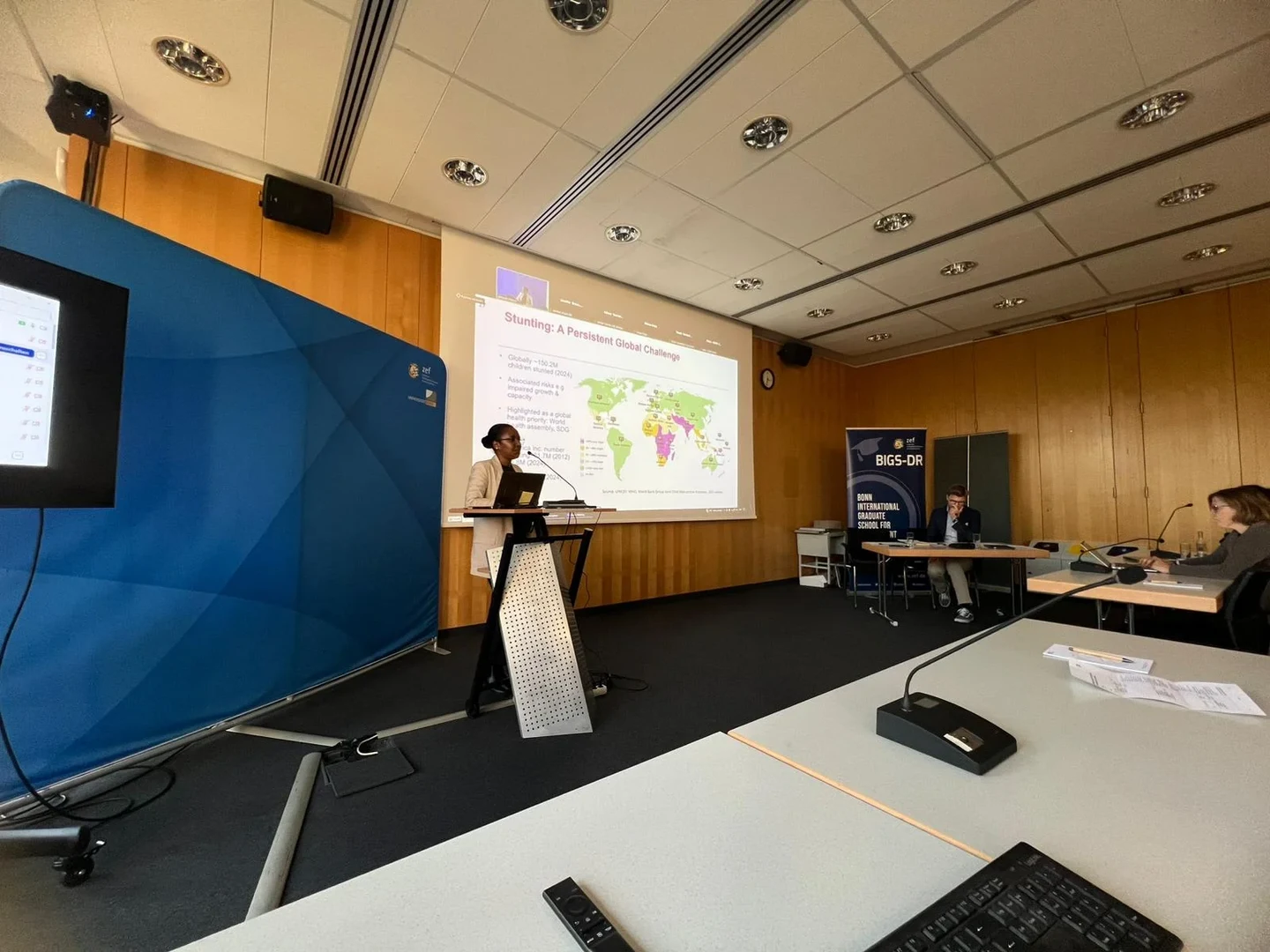
This hybrid workshop provided a platform for disseminating and discussing findings from several studies on the contextualization of stunting stagnation in sub-Saharan African countries. Participants from Zambia, Malawi, and Kenya joined to discuss global, regional, and country-level insights shared by the project team. These participants – in person and online - included government representatives from these countries, as well as representatives from the EU and international organizations such as UNICEF and the World Food Program (WFP) and the GIZ.
ZEF-Director Prof. Matin Qaim gave a presentation on “Sustainable food and nutrition security and resilient agrifood systems – a global perspective”. In this talk he highlighted global trends in food security and explained why resilient food systems are important in this context.
Dr Cecilia Maina presented regional study results in her talk “Persistent stunting and its determinants – evidence from the region”, focusing on how crises affect progress in stunting.
In the presentation “Same same, but different: examining drivers of country-level progress in malnutrition – three examples“, Dr Janosch Klemm shared findings from the country-level analysis. He provided insights into how these regional findings translate to the country-level context and the unique challenges that exist.
The event concluded with a presentation by Tendai Gunda, the Regional Representative of the Scaling Up Nutrition Movement for Anglophone Africa. She shared insights into how regional evidence is utilized in country-level programs within SUN countries.
The findings of the study were condensed into four policy briefs: regional, Kenya, Malawi, and Zambia, which will be made available on the ZEF website shortly.
ZEF-Director Prof. Matin Qaim gave a presentation on “Sustainable food and nutrition security and resilient agrifood systems – a global perspective”. In this talk he highlighted global trends in food security and explained why resilient food systems are important in this context.
Dr Cecilia Maina presented regional study results in her talk “Persistent stunting and its determinants – evidence from the region”, focusing on how crises affect progress in stunting.
In the presentation “Same same, but different: examining drivers of country-level progress in malnutrition – three examples“, Dr Janosch Klemm shared findings from the country-level analysis. He provided insights into how these regional findings translate to the country-level context and the unique challenges that exist.
The event concluded with a presentation by Tendai Gunda, the Regional Representative of the Scaling Up Nutrition Movement for Anglophone Africa. She shared insights into how regional evidence is utilized in country-level programs within SUN countries.
The findings of the study were condensed into four policy briefs: regional, Kenya, Malawi, and Zambia, which will be made available on the ZEF website shortly.