Main take-aways
How research can contribute to achieving health improvements and sustainable diets as well as to reducing risks of non-communicable diseases (Day 1)
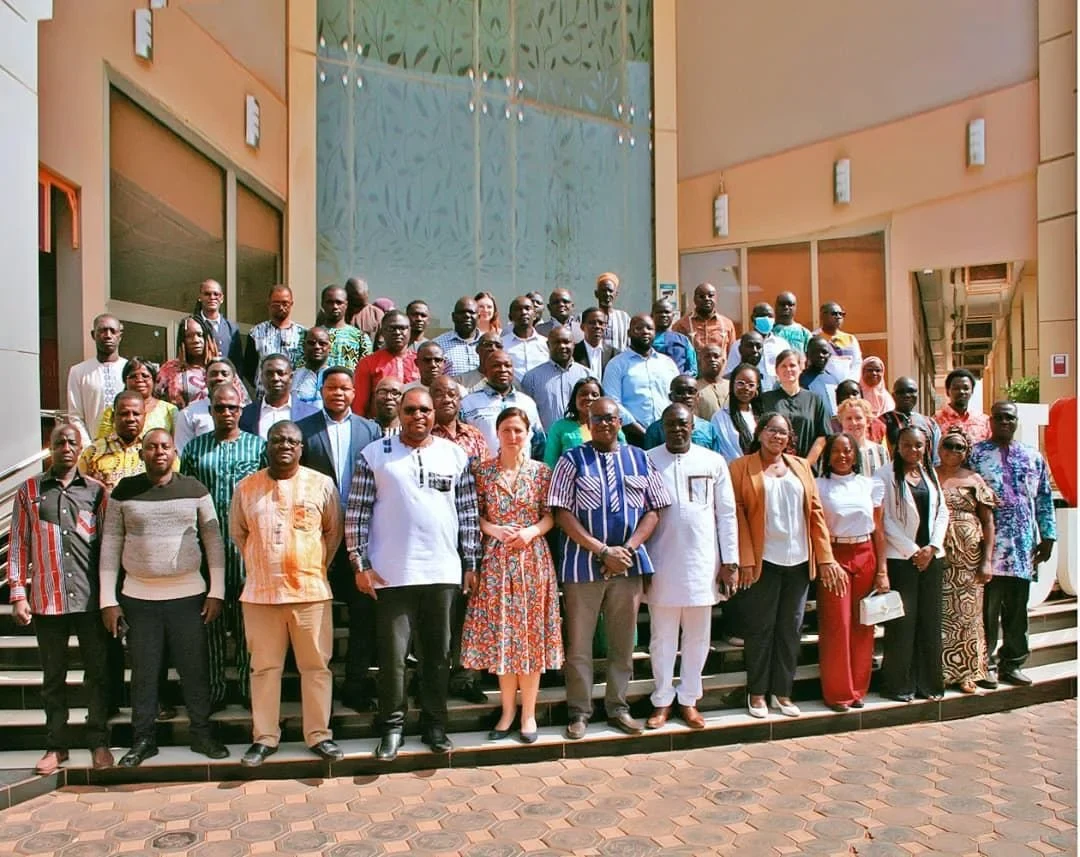
Dr. Issa Ouedraogo, Secretary General of the Burkina Faso Ministry of Health launched the workshop through his opening remarks. On the first day, project representatives provided an overview of the projects’ procedures and key findings.
The first session was dedicated to the dissemination of results from the DFG-funded Research Unit “Climate Change and Health in sub-Saharan Africa”, for which Ina Danquah is the spokesperson. The presenters reported health improvements through i) integrated nutrition-sensitive and nutrition-specific interventions to combat child undernutrition, ii) transmission modeling for malaria with and without bed net usage, and iii) passive cooling systems against indoor heat stress.
The second session highlighted the results of the Robert Bosch Foundation-funded project “Sustainable Nutrition in sub-Saharan Africa”, of which Ina Danquah is the Principal Investigator. This comprised a dietary weight-loss intervention in Ouagadougou, presented by Ms. Anais Gonnet (Heidelberg Institute of Global Health, HIGH and UoB), and the ALIMUS – We are Feeding! project – a home gardening and nutrition counselling intervention in rural Burkina Faso, presented by Dr. Raissa Sorgho (UoB). Ms. Gonnet showcased the possibilities of attaining sustainable diets as a means of diabetes prevention in Burkina Faso through physical activity, nutrition counselling, guided market visits, and educative cooking sessions. Dr. Raissa Sorgho shared the positive results of the integrated intervention, which improved nutrient adequacy and nutritional status of young children in rural Burkina Faso.
The third session introduced the “Changemaker” project, an implementation science project for a sustainable health intervention to reduce the risks of non-communicable diseases among adolescents in urban Burkina Faso, Kenya, and Tanzania. The project is coordinated by Prof. Dr. Kristi Sidney Annerstedt at Karolinska Institute and co-led by Ina Danquah at UoB. The co-design and co-creation of the intervention components have taken place in 2024/2025; baseline assessments are currently being conducted; and implementation of the intervention has commenced in Kisumu and Ouagadougou.
The snapshot of Day 1 sessions and the overall remarks of Prof. Ina Danquah were broadcasted by the Burkina Faso National Tv (https://youtu.be/EIFxCAugRM4?si=RsrkrLXO0aC-JvVE).
How collaborative research can contribute to policy-making, how researchers deal with challenges and constraints and how Burkina Faso can benefit from technology-supported health interventions (Day 2)
Together with partners from HIGH and Kenya Medical Research Institute (KEMRI), the principal investigators Dr. Ali Sié (CRSN), Prof. Dr. Abdramane Soura (ISSP), and Prof. Dr. Ina Danquah (UoB) met Hon. Dr. Robert Lucien Jean-Claude Kargougou, the Minister of Health of Burkina Faso. They discussed the contributions of the collaborative research to evidence generation and policy making in Burkina Faso.
This second day was dedicated to domain and methods-specific workshops in parallel breakout sessions. Three sessions focused on maintenance, scaling and spread of the projects’ activities beyond the funding period. Facilitated by Dr. Raissa Sorgho (UoB), Ms. Anais Gonnet (HIGH and UoB), and Prof. Dr. Manuela De Allegri (HIGH), the participants from practice and politics highlighted challenges related to social support, financial constraints, lack of political will, and fear of change. They provided avenues to overcome these challenges, such as strong partnerships and strategic investment goals. The sessions also included demonstrations of novel tools for the assessment of nutritional status, including the new MUACz-score tape.
Additional sessions contributed to discussions on technology-supported health promotion, disease prevention, and treatment in Burkina Faso. This included wearable-based technology for health parameters, indoor sensors for environmental measures (Dr. Sandra Barteit, HIGH), and non-invasive devices for health examinations (Ina Danquah, UoB). Further, results with regard to the prevention of malaria transmission in times of a changing climate were discussed by Dr. Joshua Ntajal (UoB), Dr. Diarra Dieng (Karlsruhe Institute of Technology, KIT), and Dr. Nafissa Traoré (Swiss Tropical and Public Health Institute). Ultimately, the economic impacts of interventions within the nexus of climate change and health were presented for the household level (Prof. Ina Danquah, UoB) and for the national level (Dr. Zuhal Elnour, Humboldt University Berlin).
Field visits for touching ground (Day 3)
The third day included three field visits to i) community gardens in the Green Belt of Ouagadougou, ii) an intervention home with passive cooling technology within the Ouagadougou Health and Demographic Surveillance System, and iii) two intervention schools of the “Changemaker” project, where school gardens are being established. The site visits served the purposes of demonstration, engagement with community members, gaining contextual understanding of the intervention activities, and formulation of new research questions.