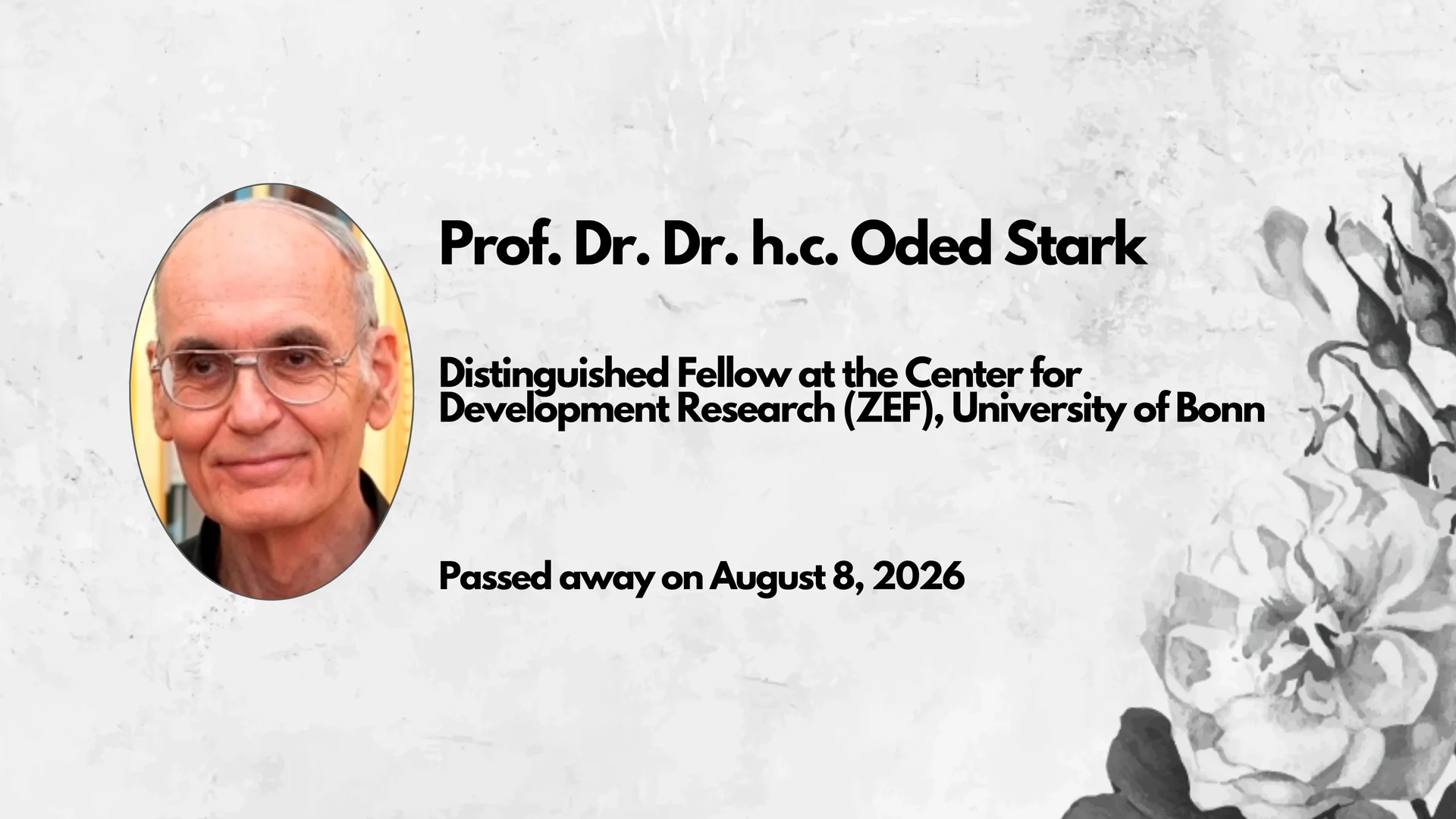
Professor Stark began his cooperation with ZEF in 1998, the very first year of ZEF's doctoral program, serving as both teacher and researcher. Two years later, the Alexander von Humboldt Foundation awarded him the prestigious Humboldt Research Award, which further strengthened his ties with ZEF and the University of Bonn. His willingness to engage already in the early days with the nascent economics team at ZEF put the young institute on a track of setting highest academic standards.
Professor Oded Stark was one of the world's leading scholars in the fields of migration, population, and development economics, with additional contributions to microeconomic theory, labor and welfare economics, and evolutionary economics. His pathbreaking research on labor migration and non-market transfers was a creative achievement that consistently redefined and pushed forward the research frontier. This work demonstrated that labor migration is more than a response to wage differentials; it placed the family, rather than the individual, at the heart of migration economics. It also showed migration to be a means of alleviating constraints such as risk and limited credit at the place of origin, as well as a catalyst for human capital formation. He was a co-founder of the New Economics of Labor Migration, an approach that significantly reshaped how economists analyze migration decisions by highlighting the roles of family, risk, and income transfers in migration.
For many years, Professor Stark actively contributed to the academic life of ZEF. He taught courses for doctoral candidates, collaborated with young researchers, and supported their scholarly development. For many young economists, working with him was a crucial step toward entering the international academic community. When he was at ZEF, students lined up in front of his office to seek his advice.
Professor Stark passed away on August 8, 2026. Characteristically, just six days before his passing, he submitted yet another scholarly paper to the ZEF Paper Series, titled "Efficient Joint Savings Groups" — adding to a body of work of more than 100 papers, all of which were eventually published in high-ranking journals.
Besides ZEF at the University of Bonn, Professor Oded Stark was affiliated with numerous prestigious universities and research centers, including Harvard, Georgetown, and the Universities of Warsaw, Oslo, Vienna, and Tübingen.
The death of Professor Oded Stark is a great loss to the international economics community. His outstanding scholarly work and his significant contributions to economic research will endure as a lasting legacy.
We at ZEF extend our deepest condolences to Professor Stark's family and loved ones.