14. September 2026

"Forest management and conservation in Sub-Saharan Africa require both participatory and non-participatory research to capture the social, biophysical and spatial dimensions of forests" Fatima Ali obtains her doctoral degree for thesis on Participatory Valuation of Forest Ecosystem Services in Sudan

Fatima Salaheldin Mohamad Ali obtains her doctoral degree for her thesis on Participatory Valuation of Forest Ecosystem Services in Sudan

Fatima Salaheldin Mohamad Ali was granted her doctoral degree by the Faculty of Agricultural, Nutritional and Engineering Sciences, University of Bonn, Germany. She successfully defended her doctoral thesis on "Participatory Valuation of Forest Ecosystem Services: A Synthesis of Sub-Saharan Africa and a Case Study from Sudan". 

The supervisors of her doctoral research were Prof. Dr. Lisa Biber-Freudenberger and Prof. Dr. Christian Borgemeister. Her work was tutored by Dr. Jan Henning Sommer.

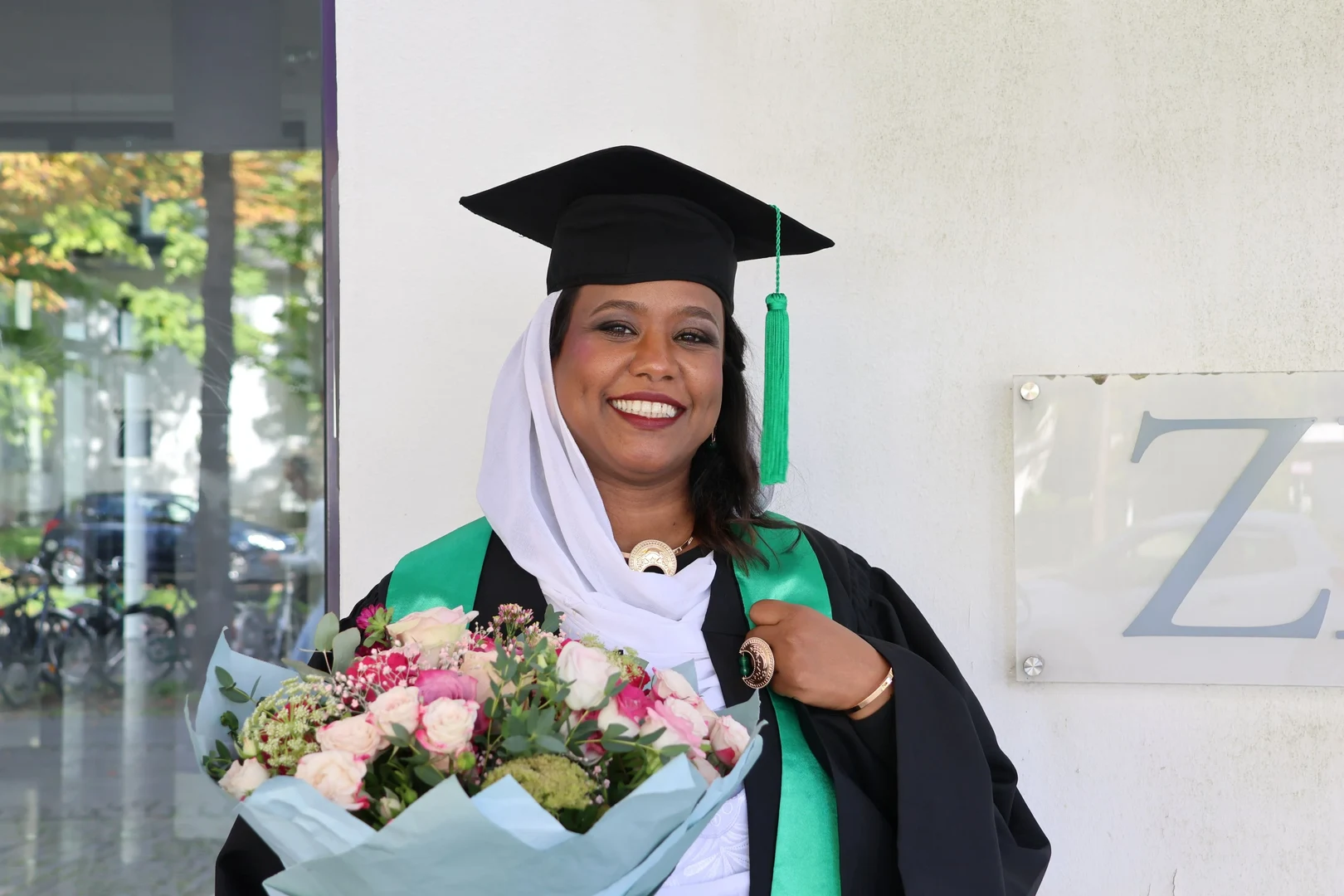
Fatima Ali after her successful doctoral defense at ZEF
Fatima Ali after her successful doctoral defense at ZEF © ZEF PR/Akinlade
Download all images in original size The impression in connection with the service is free, while the image specified author is mentioned.
Please fill out this field using the example format provided in the placeholder.
The phone number will be handled in accordance with GDPR.

Fatima's main take-aways from her doctoral research

  • My research examines how participatory and non-participatory research approaches can help us better understand and value forest ecosystems in Sub-Saharan Africa. 

  • I conducted three studies. First, I compared participatory and non-participatory approaches across the published literature in Sub-Saharan Africa. Second, I applied a participatory approach in a case study of a Gum Arabic-forest in Sudan, where I explored how local communities value different forest ecosystems. Third, I integrated community narratives of past forest use and conditions with land-use and land-cover analysis.

  • The main takeaway of the research is that we need both approaches. Participatory research captures forest users’ perceptions, knowledge and preferences, while non-participatory research helps us measure forest conditions and changes across space and over time. Together, they provide a more complete picture of the social, biophysical and spatial aspects of forests. This can support more integrated forest management and conservation.

  • The Sudan case study also shows the practical relevance of this research. Gum Arabic-producing forests in Sudan support local livelihoods and biodiversity while also providing Gum Arabic, an important global commodity used in food, medicine and many other products. 

  • Sudan is the world’s largest producer of raw Gum Arabic. However, focusing only on increasing Gum Arabic production without considering local livelihoods and biodiversity conservation may put these forests at risk. 

  • A more integrated approach is therefore needed to balance Gum Arabic production, local livelihoods and biodiversity conservation.
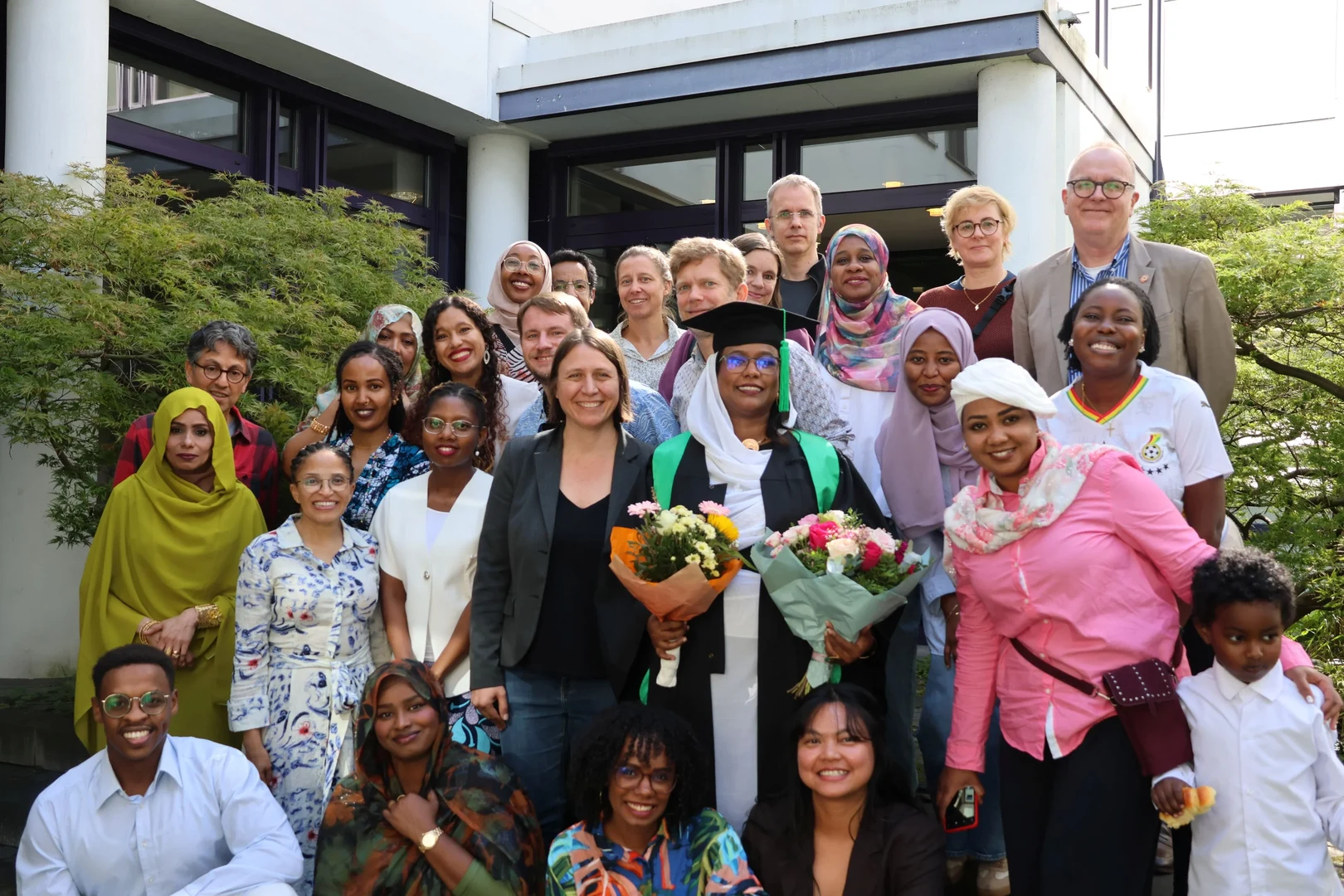
Fatima with ZEF colleagues, family and friends at her graduation ceremony
Fatima with ZEF colleagues, family and friends at her graduation ceremony © ZEF PR/Akinlade
It is Dr. Fatima Ali now
It is Dr. Fatima Ali now © ZEF PR / Akinlade

"This participatory research would not have been possible without the support and collaboration of local communities in Sudan. I am deeply grateful to everyone who opened their homes and hearts to me with such hospitality and kindness throughout eight months of fieldwork. My sincere thanks to the communities of Alkandi, Alhjeer, Kardos, Algazaaer Al-Agaliyin, Algazaaer Alguba, and Singa in Sinnar State".


  • German Academic Exchange Service (DAAD)

  • Pathway to Research Program, University of Bonn

  • Ali, F.S.M., Sommer, J.H., Borgemeister, C. et al. Participatory and non-participatory forest ecosystem services valuation in Sub-Saharan Africa: a systematic literature review. Discov Sustain 6, 199 (2025). https://doi.org/10.1007/s43621-025-00907-5

  • Fatima Salaheldin Mohamad Ali, Ahmed A.H. Siddig, Jan Henning Sommer, Christian Borgemeister, Lisa Biber-Freudenberger,
    Valuing ecosystem services in Sudan: a participatory study of the Okalma reserved forest, Trees, Forests and People, Volume 23, 2026, 101139, ISSN 2666-7193, https://www.sciencedirect.com/science/article/pii/S2666719325003656?via%3Dihub

Wird geladen